
The Holonomic Circle · Self-Assessment
Is your organisation designed with soul?
A 36-question checklist to assess how well your organisation embodies the Holonomic Circle across three critical dimensions of experience.
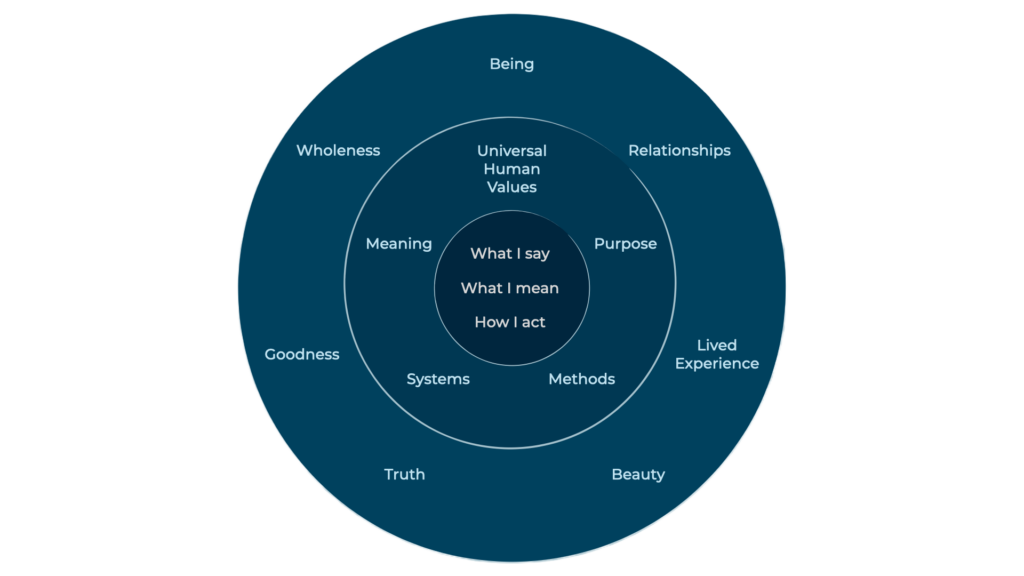
The Holonomic Circle is a systems-based customer experience framework designed to help leaders integrate Leadership Experience (LX), Employee Experience (EX) and Customer Experience (CX).
It describes the conditions, tools and techniques — and the deeper qualities of meaning, coherence and authenticity — required to design customer experiences that genuinely express soul. Rather than treating CX as a function or programme, it positions experience as an expression of how an organisation understands itself and acts in the world.
The framework supports the design of experience-based organisational interventions — such as leadership workshops, strategic communication events and sensemaking processes — that enable people to understand and enact strategy together. This approach strengthens alignment through shared understanding and responsibility, allowing individuals at every level to see themselves as contributors to the whole system.
The Holonomic Circle, therefore, provides a disciplined, systems-based approach enabling leaders to build organisations that are not only operationally effective, but deeply human.
How to use the Holonomic Circle Checklist
To support you in assessing where your organisation stands today, we have developed a diagnostic checklist — drawn directly from the Holonomic Circle — that reveals the degree to which your Customer, Employee and Leadership Experience embody these qualities, and points you towards the specific tools and frameworks in Designing Customer Experiences with Soul that will help you close the gaps.
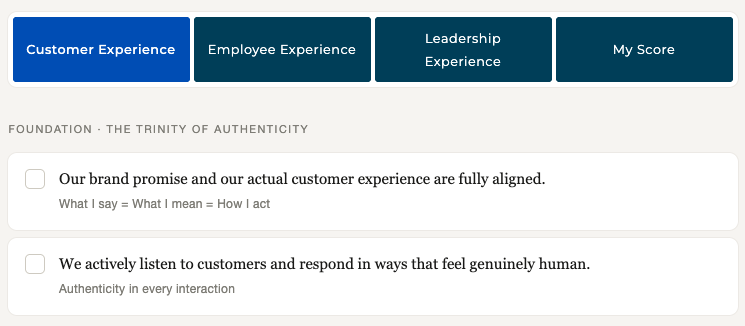
The checklist consists of 36 questions that cover customer experience (CX), employee experience (EX) and leadership experience (LX). Each question relates to one specific dimension of the Holonomic Circle.
Once you have completed the first 12 questions on customer experience, you can then click on the Employee Experience button to move on to the next 12 questions. When you have finished, click on My Score to see how well your organisation expresses soul.
The feedback also includes recommended tools from Designing Customer Experiences with Soul to help you with the stage that you have reached in your journey.
The checklist as a tool for dialogue
While traditional CX metrics can tell you how much or how many, this checklist asks how well. It focuses on the qualities of experience—authenticity, empathy and integrity—relating to customers, employees and leaders. In business today where customers are increasingly looking for brands with ‘soul’, this qualitative focus is a significant competitive advantage.
The checklist doesn’t just identify what is broken; it reveals the systemic disconnects that prevent an organisation from being truly loved by its customers.
It is particularly effective when used as a recurring health check, for example to ensure that as a company grows, it doesn’t lose the original essence or ‘soul’ that made it successful in the first place.
The checklist was therefore created as a way to introduce conversations about soul in organisations. It can be completed either individually or in small groups as a way to explore the different qualities of soul and the extent to which these are present in your place of work.
Here are two real-world case studies of how the Holonomic Circle was used in the context of branding, customer experience and strategy execution:
Mapping the Soul of a Brand: How one of Brazil’s premier design labs and independent creative leaders are using the Holonomic Circle to create powerful, soul-driven customer experiences
When Experience Design Fails, It’s Usually a Systems Problem: What Hospital Sírio-Libanês taught us about designing experiences from the inside out
Completing the checklist together with colleagues will result in rich dialogues enabling you and your teams to discuss where and how to design customer experiences that truly express soul.